Uber Technologies (UBER)·Q4 2025 Earnings Summary
Uber Tanks 8% After Hours as EPS Misses Despite Record Trips
February 4, 2026 · by Fintool AI Agent
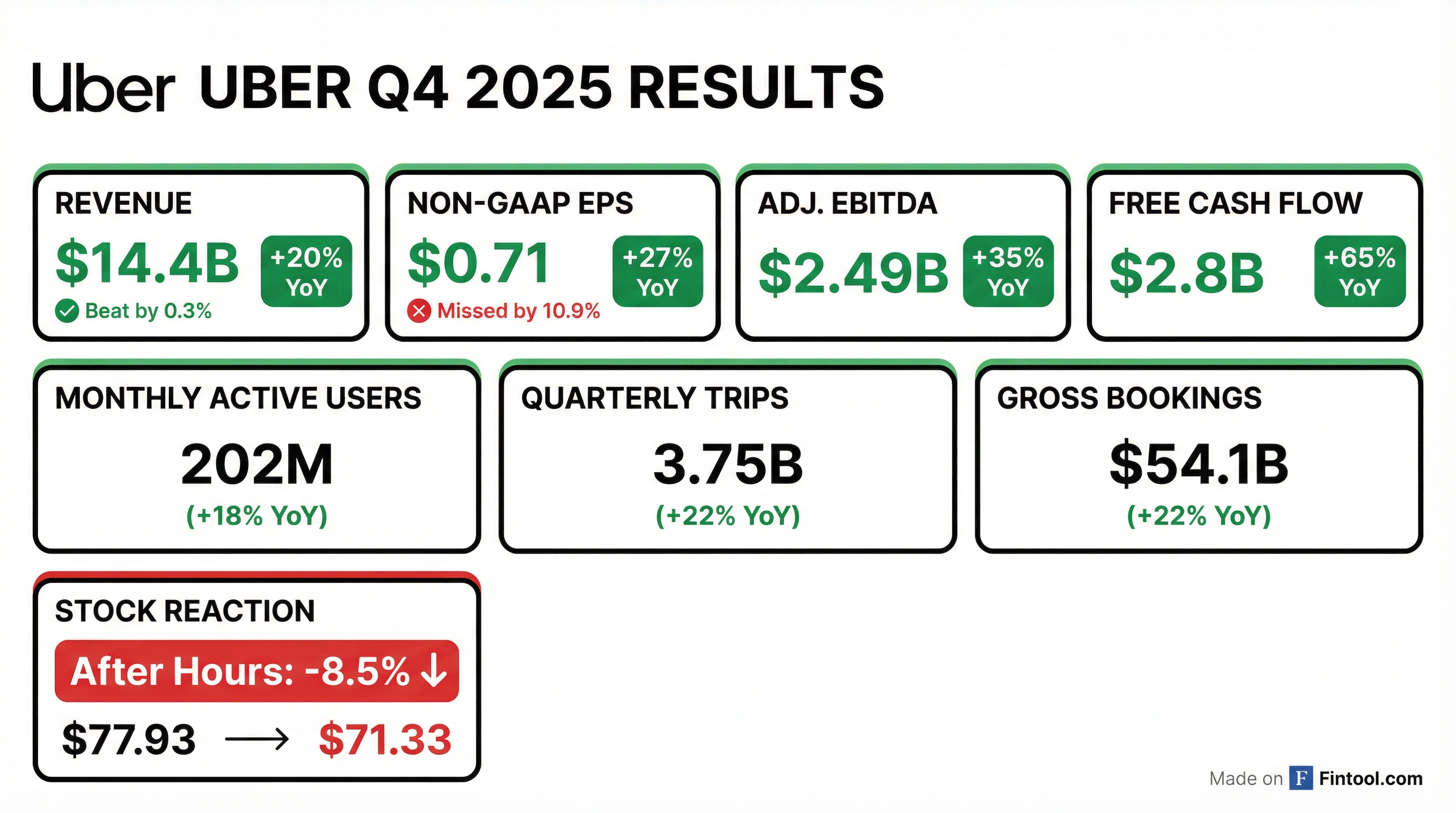
Uber delivered record quarterly trips and gross bookings but missed EPS expectations, sending shares down 8.5% after hours to $71.33 . The miss came despite 22% year-over-year growth in both trips (3.75 billion) and gross bookings ($54.1 billion). Q1 2026 EPS guidance of $0.65-$0.72 came in well below consensus, and the company announced a CFO transition .
Did Uber Beat Earnings?
Revenue: Beat by 0.3% | EPS: Missed by 10.9%
*Values retrieved from S&P Global
GAAP net income was just $296 million, down from $6.9 billion in Q4 2024, due to a $1.6 billion pre-tax headwind from equity investment revaluations .
What Did Management Guide?
Q1 2026 guidance disappointed the Street:
*Values retrieved from S&P Global
The EPS guidance midpoint of $0.685 sits 13% below consensus expectations—the primary driver of the after-hours selloff.
 Ask Fintool AI Agent
What Changed From Last Quarter?
Positives:
- Monthly Active Platform Consumers hit 202 million, up 18% YoY and crossing 200M for the first time
- Free cash flow of $2.8 billion marked a quarterly record, up 65% YoY
- Full-year 2025 free cash flow reached $9.8 billion
- Delivery segment Adj. EBITDA grew 40% YoY to $1.02B
Concerns:
- GAAP income from operations inflected lower on a percentage basis despite absolute growth
- Q1 guidance implies margin compression vs Q4
- Currency tailwind of ~4 percentage points in Q1 means underlying growth is weaker than headline numbers
Segment Performance
Delivery continues its margin expansion story, now contributing 41% of segment Adj. EBITDA (up from 39% in Q4 2024). Freight reached breakeven after operating at a loss in prior quarters .
CFO Transition
Prashanth Mahendra-Rajah will step down as CFO on February 16, 2026, to take a government role. On the call, he stated he's leaving "to serve America and give back to the country"—an announcement expected soon . Balaji Krishnamurthy, currently VP of Strategic Finance, will assume the role.
Krishnamurthy, 41, joined Uber in 2019 and led Investor Relations from 2020-2023 . His compensation package includes:
- Base salary: $600,000
- RSU awards: $9.375M (time + performance vesting)
- Stock options: $3.125M
- One-time RSU grant: $5.0M
On the call, Balaji described the company's position: "An accelerating core business supported by huge and increasingly active consumer, earner, and merchant base, large and growing cash flows, which we can use strategically to invest into our future" .
Ask Fintool AI AgentHow Did the Stock React?
The after-hours drop of 8.5% represents the largest post-earnings decline since Q1 2024. UBER is now trading near its 52-week low of $60.63, well off its 52-week high of $101.99.
Key Management Quotes
Dara Khosrowshahi, CEO — On AVs:
"AVs will unlock a multi-trillion-dollar opportunity for Uber. AVs amplify the fundamental strengths of our platform—global scale, deep demand density, sophisticated marketplace technology, and decades of on-the-ground experience matching riders, drivers, and vehicles all in real time."
Dara — On Competition:
"We are the winner who has taken most. And that wasn't always the case. It is because of how we built the fact that we have this international footprint, the fact that we go broader than our competitors, and the fact that we are multi-product."
Balaji Krishnamurthy, incoming CFO — On Capital Allocation:
"This is not a trade-off for us in the sense that we are choosing one or the other. We're able to do all of these things in parallel... Our stock remains really cheap. We will continue to be aggressive buyers of our stock."
Prashanth Mahendra-Rajah, outgoing CFO:
"A new opportunity presented itself where I could serve America and give back to the country that has given me and my family so much."
Full Year 2025 Highlights
Balance Sheet Snapshot
The company repurchased $6.5 billion of stock during 2025, up from $1.3 billion in 2024 .
Q&A Highlights
AV Competitive Positioning
Justin Post (Bank of America) asked about AV market share risk in major cities. Dara emphasized that AVs are growing the overall pie—San Francisco, Austin, and Atlanta bookings have all accelerated with AV presence .
Balaji added crucial context: 70% of the US is outside the top 20 markets, and 75% of US profits come from those non-top-20 markets. These areas are "unlikely to be addressed by AVs for a long time" .
U.S. Acceleration Drivers
Mark Mahaney (Evercore) questioned the unusual acceleration at scale. Balaji explained:
- Insurance has shifted from a "deleveraging cost item" to providing leverage, enabling price stability
- Barbell strategy (low-end Wait & Save + high-end XXL/Reserve) growing 40% YoY
- Sparse markets growing 1.5x faster than dense markets but represent only 20% of global trips
AV Data Strategy
Doug Anmuth (JP Morgan) asked about data and simulation. Dara revealed a partnership with NVIDIA to build a "real-world data collection factory" targeting 3 million+ hours of passenger AV-specific data (pickups, drop-offs, edge cases). This data will be shared with AV partners to "democratize AV data" .
Capital Returns Philosophy
Brian Nowak (Morgan Stanley) asked about the 50% FCF return commitment. Balaji confirmed:
"Based on our current visibility... we will continue to be aggressive buyers of our stock, and you should expect that it continues at a steady cadence. And we are on track to reducing our share count by a healthy amount."
Delivery Growth Framework
John Colantoni (Jefferies) asked about delivery sustainability. Dara outlined 5 growth pillars:
- Selection — Still 30-40% of addressable market in many countries
- Less Dense Areas — Suburban category position significantly below cities
- Grocery/Retail — 5 of top 10 US grocers; new multi-year exclusive with Coles (Australia's largest)
- Membership — 46 million members, growing 55% YoY, approaching 50% of gross bookings
- International Expansion — Now #1 in UK and Japan (both organic), neck-and-neck in Germany
Ask Fintool AI AgentAV Strategy Deep Dive
Management dedicated significant time to the AV opportunity, revealing several strategic updates:
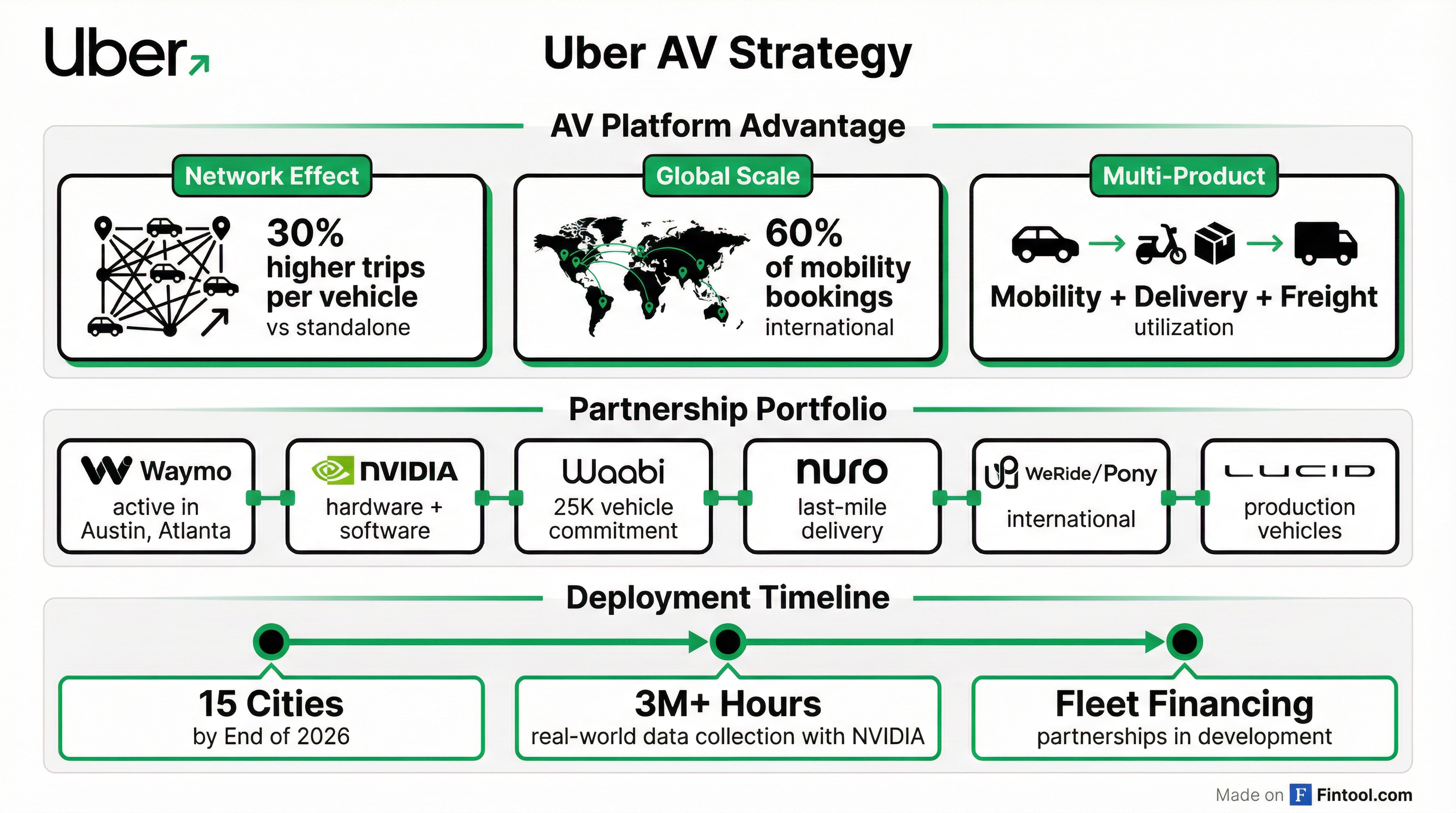
Partnership Portfolio:
- Waymo — Active in Austin and Atlanta with 30% higher trips per vehicle per day vs standalone
- NVIDIA — Hardware platform + full self-driving software development
- Waabi — New investment with first 25,000 passenger vehicles exclusive to Uber
- Others — Pony, WeRide, Baidu (international), Nuro, Lucid, AVRide
Deployment Timeline:
- Expect to be in 15 cities by end of 2026
- Typical launch sequence: driver in vehicle → driverless (as demonstrated in Abu Dhabi)
Economic Model:
- Deals being struck today have "healthy economics based on current consumer fares"
- Fleet financing discussions with private equity, banks for both EVs and AVs
- CEO drew parallel to Marriott: "Just like Marriott doesn't have to own its hotels, you've got REITs that own their hotels"
Deployment Strategy (Balaji): AVs will initially serve "baseload supply at the trough of the week's demand curve." Saturday-to-Monday demand drops 45% for traditional rides but AVs maintain consistent demand. Only at significant scale will AVs expand beyond trough-level utilization .
Audience & Engagement Metrics
Uber disclosed strong engagement trends:
Balaji noted that new rider/eater cohorts are exhibiting "much stronger retention than prior cohorts" due to early lifecycle investments and multi-product cross-sell .
Forward Catalysts
- AV Scale-Up: 15 cities by year-end 2026; fleet financing partnerships in development
- Delivery Profitability: 40% YoY EBITDA growth positions Delivery as a key margin driver
- Insurance Tailwind: Reform creating leverage vs. prior headwinds
- Capital Returns: Aggressive buybacks continuing; "stock is really cheap" per Balaji
- Grocery Expansion: 5 of top 10 US grocers with more announcements coming
Ask Fintool AI AgentBottom Line
Uber's Q4 results showcase the tension between operational excellence and near-term profitability expectations. Record trips (15B annualized), 202M monthly users, and $9.8B full-year free cash flow couldn't offset an EPS miss and soft Q1 guidance.
However, the earnings call revealed a management team laser-focused on long-term positioning. The AV strategy is maturing—15 cities planned by year-end, profitable unit economics on new deals, and 30% higher utilization on Uber's network vs standalone platforms. The delivery business has 5 clear growth pillars. Insurance has flipped from headwind to tailwind.
The CFO transition—with Prashanth leaving for a government role—adds uncertainty, but Balaji's deep institutional knowledge and emphasis that the stock is "really cheap" signals confidence. At 30% off the 52-week high, the question is whether the market is pricing in execution risk or missing the platform leverage ahead.